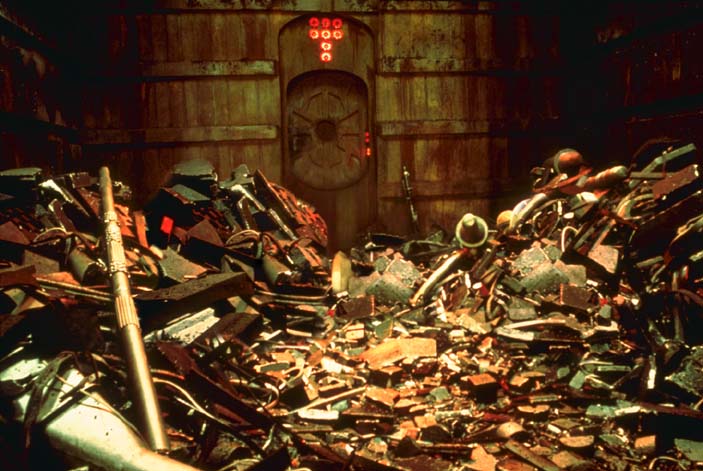
The power went out Monday morning in the MeRF, allowing for an eerie distraction from normal routine upon entering the plant. The front doors were locked (since they run on automatic power), so I entered the recycling facility through the bat cave entrance to the sound of shovels scraping glass and other discards that fall to the production floor off the lines. Back-up power allowed for basic lighting and heat, but the isolated system disturbance caused by a weekend snow storm allowed for strictly manual tasks to be performed. No coffee or computing, the hallmarks of morning office routine. I was ready to brave the velociraptors and make it to the caged bunker housing the manual override controls when the power abruptly came back on after about an hour. Life returned to normal.
Our reliance on electricity is staggeringly taken for granted, so much so that we don't know how to live without it. Think about all the kitchen appliances, electronics and heating/AC/wired systems you use in during the day and imagine living a year or even a month without them. That's what Colin Beavan and his family did as an experiment, living without any energy emissions, new products or even (egads!) toilet paper for a year calling himself the "No Impact Man." With a book and movie deal promised beforehand by an agent I would probably not hesitate to do something equally as sensational. I must have missed the documentary at Silverdocs, but I plan to see the film at some point. The environmental impact, or lack thereof, by the Beavan family over the course of the year (one family produces 1600 pounds of waste), let alone the attention garnered by such an act, shows us that it's possible for individuals other than superheroes to start saving the world. My comrade Davey Rogner plans to walk across America picking up trash in Spring 2010 highlighting the need for better waste stream management and the incredible amount of trash Americans produce and discard. Putting aside the debate over whether "eco-stunts" work, the Beavan family and Rogner show us that it's possible to live an extreme zero waste lifestyle, albeit uncomfortable and humbling.
What's more important for us is to learn from these examples and start making changes in the way we consume, the way we discard, and the way we interact with the earth. This message is even more important as the holidays approach. There is an estimated 25% increase in solid waste during the holidays according to Waste & Recycling News. This is due to an increase in shopping, the packaging that gifts go through in their lifespans as gifts, the abundant spreads of food and drank at feasts and parties (Winter Ales here I come). Eco-Cycle has released their guide to making the holidays more eco-friendly, (non-residents can disregard the local Colorado info towards the bottom).
Among the top priorities you should consider this season is using recycled cards and gift wrap, or substituting hard-to-recycle gift wrap with newspaper, fabric or cloth wrapping materials. Try not to use any polystyrene peanuts or bubble wrap, as much fun as popping them compulsively is. Buying local, used, or recycled gifts cut down on an item's ecological footprint by not using virgin materials or transportation costs as do gifts that keep on giving like bikes, rechargeable batteries, reusable cloth bags or activity gifts like tickets to a ball game or concert. Setting up a compost bin during family feasts is important to save on food waste and potential fertilizer. Don't send your Christmas tree to a landfill, compost it out back. Recycle any old electronics that you may be replacing with newer versions at responsible recycling locations (look on Earth911.org for help with this). Donate any unused gifts from past years to thrift stores and deliver surplus food to homeless shelters. Following some of these simple steps will help decrease the waste load and contribute to less habitants on the Island of Misfit Toys.
Monday, November 23, 2009
Holiday in Cambodia

Thursday, November 5, 2009
Colorado Scraps Tire Recycling Funding
Colorado Loses Funding for Tire Recycling
by Trey Granger (reposted from Earth911.org)
In an effort to balance the state’s budget, Colorado Gov. Bill Ritter has cut the $4 million funding that would have been used to clean up the largest tire stockpile in the nation, according to The Denver Post.
The program is funded through a $1.50 tax on all new tires sold, which also helps pay for other recycling programs. But because of a $318 million shortfall in the current budget, $2.7 million was eliminated through June 2010 and all cleanups and recycling incentives have been suspended until further notice.
The EPA estimates that 45 percent of all scrap tires are burned for energy. Since the average tire contains 5 gallons of oil, they can generate comparable energy to crude oil or coal.
One of the larger collection facilities in Hudson was recently purchased by Magnum Recycling, which will attempt to convert the stockpile into rubber powder that can be turned into new tires.
This week, the company held a media event with state legislators in attendance to unveil the renovated facility and discuss its plans.
Another site, Colorado Tire Recycling (CTR), recently announced it has partnered to convert its tires into fuel and supply the fuel to Novo Energies Corp. CTR collects more than 12,000 tons of tires each year, but the state generates an estimated 4 to 5 million tires annually.
The fear is that those facilities that relied on state funding will begin stockpiling tires without actually recycling them, since it can cost more to generate crumb rubber from the tires than the current value of the material.
Colorado is not the only state where an environmental program was cut due to budget shortfalls. In Wisconsin, the Clean Sweep program that collected hazardous waste from 40 communities went under in March because its grant was removed. The University of Arizona lost its composting program in August due to state budget cuts as well.
by Trey Granger (reposted from Earth911.org)
In an effort to balance the state’s budget, Colorado Gov. Bill Ritter has cut the $4 million funding that would have been used to clean up the largest tire stockpile in the nation, according to The Denver Post.
The program is funded through a $1.50 tax on all new tires sold, which also helps pay for other recycling programs. But because of a $318 million shortfall in the current budget, $2.7 million was eliminated through June 2010 and all cleanups and recycling incentives have been suspended until further notice.
The EPA estimates that 45 percent of all scrap tires are burned for energy. Since the average tire contains 5 gallons of oil, they can generate comparable energy to crude oil or coal.
One of the larger collection facilities in Hudson was recently purchased by Magnum Recycling, which will attempt to convert the stockpile into rubber powder that can be turned into new tires.
This week, the company held a media event with state legislators in attendance to unveil the renovated facility and discuss its plans.
Another site, Colorado Tire Recycling (CTR), recently announced it has partnered to convert its tires into fuel and supply the fuel to Novo Energies Corp. CTR collects more than 12,000 tons of tires each year, but the state generates an estimated 4 to 5 million tires annually.
The fear is that those facilities that relied on state funding will begin stockpiling tires without actually recycling them, since it can cost more to generate crumb rubber from the tires than the current value of the material.
Colorado is not the only state where an environmental program was cut due to budget shortfalls. In Wisconsin, the Clean Sweep program that collected hazardous waste from 40 communities went under in March because its grant was removed. The University of Arizona lost its composting program in August due to state budget cuts as well.
Hard-to-Recycle Item #3: Consumer Product Packaging
Something's got to be done about the enormous plastic packaging sum rung up by manufacturers if our communities ever want to have a chance of reaching zero waste. Approximately a third of waste sent to landfills is consumer product packaging (Origins). This includes chip and candy wrappers, saran and shrink wrap, bad rap and pop CD cases, frozen and ready-to-eat meals, beer pong cups, cosmetic supplies; all of the stuff you usually throw in the trash because its not recyclable. A good way to identify CPP (this isn't actually an official acronym, but the recycling industry is full of them, so I'm just going to follow the trend..) is if it's made of plastic and/or contains a consumable product inside (duh!). Unfortunately, if CPP doesn't end up at the landfill, it often ends up clogging streams around fallen trees and beaver dams, not only polluting our watersheds but creating an unsightly sight suited for the Death Star's trash compactor.
The pollution caused by CPP can be directly attributed to the flood of new plastic materials marketed to suburban America and the new middle class after World War II. Since then, single-use packaging has increased by more than 10,000% (EPA), a staggering percentage comprehensible only by a huge exponential growth curve that doesn't fit in this blog space. The Society of the Plastics Industry and entrepreneurs like Earl Tupper applied the scientific developments of the past century's plastic invention and chemical manipulation to a fast-growing list of consumer products, mainly food and drink containers, advocating for its use in almost every industry. Plastic is valued for its lightweight durability and ability to mold to almost any shape. It is hard to recycle because there are so many chemical resins that vary from plastic to plastic. A number system from 1-7 is invoked to identify types of plastic and an easy chart can be found on Eco-Cycle's website. Until the 1970s there was little regulation and health concerns for the use of plastic. Indeed, the FDA did not issue any ultimatums on plastic manufacturing until 2002 when they introduced the current Good Manufacturing Initiative (cGMP), which focuses on risks to public health in manufacturing procedures and end-product quality. The private research and calls for greater study by environmental groups and universities on the hazards of plastics has yielded shocking results.
While producing plastics is known to be a toxic process that releases pollutants into the air, the finished plastic is usually much safer although trace chemicals can remain, and this is where much research needs to be done. PVC, used to make shrink wrap as well as the popular potato gun piping, can leach harmful chemicals when it comes into contact with food and the World Health Organization classifies vinyl chloride (the VC part) as a human carcinogen. Polystyrene, used to make styrofoam, used to release CFCs into the ozone until non-CFCs were used, and can leach chemicals that affect hormone functions. Polycarbonates, used to make firmer molds like CD cases and action figures, has bisphenol-A, an estrogen-like hormone disruptor thats been known to lead to increases in body weight and insulin resistance in animal studies. This stuff is nasty, and even when it's recycled properly, chemicals like dioxin are released every time plastic is burned. It should also be noted that global plastic production accounts for 8% of the world's oil consumption (Ecobiz).
Further innovation in the area of biodegradable plastics is required by manufacturers to avert a literal suffocation of our future. Some companies have been able to develop such holy grails. A class of oxo-biodegrable plastics has been invented by adding small amounts of catalytic metal salts to polyolefin (a form of shrink wrap) that when exposed to oxygen degrade over a matter of months to biomass particles. Biodegradable plastics like Biopol and Ecoflex are being developed that degrade with exposure to sunlight, water, bacteria, enzymes and other natural causes, but the materials are currently too expensive to be of any widespread industry use. A process called active disassembly (ADSM) uses shape memory alloys and polymers as well as trigger points to disassemble consumer products part by part for easy recycling. This also is costly to the consumer at the moment, but will have long-term benefits for CPP as well as electronic waste. Much work is also being done on biopetroleum, which uses sugars and algae to capture carbon dioxide and turn it into clean fuel. These technologies hold the fate of Earth's environment in their hands. While the plastics industry and American Chemical Association avidly defends the use of plastics, they need to accept responsibility for the environmental problems they've caused and actively work for, promote and cheapen these new technologies. Now I better watch my back..
Europe currently leads the way in requiring manufacturers to consider the end-life of their products and incorporate plans for such before they proceed. This is enforced through increasing legislative pressures and directives like the goal of increasing recycling rates from 75% to 85% by 2015, and the goal of eradicating landfills for hazardous waste. While a lot of Americans seem to dislike or distrust smart, proven European initiatives like universal health care and shorter work weeks, pressure of some sort needs to be exerted on manufacturers to consider the end-life of their products and to employ active disassembly techniques. This is already being set in motion by more and more examples of green corporate stewardship, but improvements like the implementation of the technologies listed above still need to be made.
In direct relation to the recycling industry, Polyflow Inc. of Ohio claims to have developed a process that turns previously unrecyclable materials like rubber, plastics, electronics and scrap metal back into raw polymer and monomer feedstock to manufacture new items creating an efficient recycling loop. The company still looks like its consolidating support and funds to jump off, but could prove to be a worthy investment in the future if they install regional plants across the nation. TerraCycle, a so-called "upcycling" company, has partnered with companies like Mars and Frito-Lay to create consumer products featuring popular candy and chip wrappers such as this Doritos tote bag and Oreo kite. Putting the obvious branding mechanism aside, this repurposing initiative diverts tons of the most popular consumer product packagaing and reminds me of the Nascar flair jackets worn a decade ago by Springbrook's urban elite. You can even get paid for collecting specific, intact wrappers and sending them in if you truly want to nickel and dime it. For all the ladies and mermen, the natural cosmetic company Origins allows you to bring in any used cosmetic products, regardless of brand, to any store location to be shipped to their recycling plant for reuse. Origins has also committed to use natural ingredients and recycled materials wherever possible in their production chain.
Another solution to the problem of consumer product packaging is simply to consume less plastic. Ask for paper bags or use renewable ones at the grocery store. Buy products with no plastic wrap around them that have a recyclable or compostable end-life, and combine similar produce items (like Gala apples and Granny smith apples, or red, green and orange Bell peppers) into one bag. Save your plastic bags from newspapers and produce, keep 'em dry, and deposit them at a safe recycling center or grocery store (search Earth911.org for a proper location). Walmart and similar big box stores are asking manufacturers to ship products to them in packages of three, which cuts down on plastic wrap, but may ultimately contribute to more plastic being used since its a switch to bulk consumption. Buy bulk only when the contents inside can be recycled. If you're having a party or large event, don't forget to invite me, but also find compostable paper plates and cups; Eco-Cycle has a Zero Waste Event Kit if you need ideas--unfortunately they don't ship.
Not only do manufacturers have to get with the program, but we as consumers need to be mindful of our buying practices and support the companies that sponsor green stewardship initiatives. The people's support for market innovations combined with government pressure and research has always led to results-oriented solutions that better our world in general. This can be seen in operation all over the green sector from the desire for clean fuels like solar and wind power to energy-saving devices like halogen light bulbs and toilets that flush less water. We must consume less plastic as a society and make a conscious shift to other materials. The will to change is stronger than any polyamide polycarbonate tupperware resin bullshit.
The pollution caused by CPP can be directly attributed to the flood of new plastic materials marketed to suburban America and the new middle class after World War II. Since then, single-use packaging has increased by more than 10,000% (EPA), a staggering percentage comprehensible only by a huge exponential growth curve that doesn't fit in this blog space. The Society of the Plastics Industry and entrepreneurs like Earl Tupper applied the scientific developments of the past century's plastic invention and chemical manipulation to a fast-growing list of consumer products, mainly food and drink containers, advocating for its use in almost every industry. Plastic is valued for its lightweight durability and ability to mold to almost any shape. It is hard to recycle because there are so many chemical resins that vary from plastic to plastic. A number system from 1-7 is invoked to identify types of plastic and an easy chart can be found on Eco-Cycle's website. Until the 1970s there was little regulation and health concerns for the use of plastic. Indeed, the FDA did not issue any ultimatums on plastic manufacturing until 2002 when they introduced the current Good Manufacturing Initiative (cGMP), which focuses on risks to public health in manufacturing procedures and end-product quality. The private research and calls for greater study by environmental groups and universities on the hazards of plastics has yielded shocking results.
While producing plastics is known to be a toxic process that releases pollutants into the air, the finished plastic is usually much safer although trace chemicals can remain, and this is where much research needs to be done. PVC, used to make shrink wrap as well as the popular potato gun piping, can leach harmful chemicals when it comes into contact with food and the World Health Organization classifies vinyl chloride (the VC part) as a human carcinogen. Polystyrene, used to make styrofoam, used to release CFCs into the ozone until non-CFCs were used, and can leach chemicals that affect hormone functions. Polycarbonates, used to make firmer molds like CD cases and action figures, has bisphenol-A, an estrogen-like hormone disruptor thats been known to lead to increases in body weight and insulin resistance in animal studies. This stuff is nasty, and even when it's recycled properly, chemicals like dioxin are released every time plastic is burned. It should also be noted that global plastic production accounts for 8% of the world's oil consumption (Ecobiz).
Further innovation in the area of biodegradable plastics is required by manufacturers to avert a literal suffocation of our future. Some companies have been able to develop such holy grails. A class of oxo-biodegrable plastics has been invented by adding small amounts of catalytic metal salts to polyolefin (a form of shrink wrap) that when exposed to oxygen degrade over a matter of months to biomass particles. Biodegradable plastics like Biopol and Ecoflex are being developed that degrade with exposure to sunlight, water, bacteria, enzymes and other natural causes, but the materials are currently too expensive to be of any widespread industry use. A process called active disassembly (ADSM) uses shape memory alloys and polymers as well as trigger points to disassemble consumer products part by part for easy recycling. This also is costly to the consumer at the moment, but will have long-term benefits for CPP as well as electronic waste. Much work is also being done on biopetroleum, which uses sugars and algae to capture carbon dioxide and turn it into clean fuel. These technologies hold the fate of Earth's environment in their hands. While the plastics industry and American Chemical Association avidly defends the use of plastics, they need to accept responsibility for the environmental problems they've caused and actively work for, promote and cheapen these new technologies. Now I better watch my back..
Europe currently leads the way in requiring manufacturers to consider the end-life of their products and incorporate plans for such before they proceed. This is enforced through increasing legislative pressures and directives like the goal of increasing recycling rates from 75% to 85% by 2015, and the goal of eradicating landfills for hazardous waste. While a lot of Americans seem to dislike or distrust smart, proven European initiatives like universal health care and shorter work weeks, pressure of some sort needs to be exerted on manufacturers to consider the end-life of their products and to employ active disassembly techniques. This is already being set in motion by more and more examples of green corporate stewardship, but improvements like the implementation of the technologies listed above still need to be made.
In direct relation to the recycling industry, Polyflow Inc. of Ohio claims to have developed a process that turns previously unrecyclable materials like rubber, plastics, electronics and scrap metal back into raw polymer and monomer feedstock to manufacture new items creating an efficient recycling loop. The company still looks like its consolidating support and funds to jump off, but could prove to be a worthy investment in the future if they install regional plants across the nation. TerraCycle, a so-called "upcycling" company, has partnered with companies like Mars and Frito-Lay to create consumer products featuring popular candy and chip wrappers such as this Doritos tote bag and Oreo kite. Putting the obvious branding mechanism aside, this repurposing initiative diverts tons of the most popular consumer product packagaing and reminds me of the Nascar flair jackets worn a decade ago by Springbrook's urban elite. You can even get paid for collecting specific, intact wrappers and sending them in if you truly want to nickel and dime it. For all the ladies and mermen, the natural cosmetic company Origins allows you to bring in any used cosmetic products, regardless of brand, to any store location to be shipped to their recycling plant for reuse. Origins has also committed to use natural ingredients and recycled materials wherever possible in their production chain.
Another solution to the problem of consumer product packaging is simply to consume less plastic. Ask for paper bags or use renewable ones at the grocery store. Buy products with no plastic wrap around them that have a recyclable or compostable end-life, and combine similar produce items (like Gala apples and Granny smith apples, or red, green and orange Bell peppers) into one bag. Save your plastic bags from newspapers and produce, keep 'em dry, and deposit them at a safe recycling center or grocery store (search Earth911.org for a proper location). Walmart and similar big box stores are asking manufacturers to ship products to them in packages of three, which cuts down on plastic wrap, but may ultimately contribute to more plastic being used since its a switch to bulk consumption. Buy bulk only when the contents inside can be recycled. If you're having a party or large event, don't forget to invite me, but also find compostable paper plates and cups; Eco-Cycle has a Zero Waste Event Kit if you need ideas--unfortunately they don't ship.
Not only do manufacturers have to get with the program, but we as consumers need to be mindful of our buying practices and support the companies that sponsor green stewardship initiatives. The people's support for market innovations combined with government pressure and research has always led to results-oriented solutions that better our world in general. This can be seen in operation all over the green sector from the desire for clean fuels like solar and wind power to energy-saving devices like halogen light bulbs and toilets that flush less water. We must consume less plastic as a society and make a conscious shift to other materials. The will to change is stronger than any polyamide polycarbonate tupperware resin bullshit.
Tuesday, October 27, 2009
Hospital in Wisconsin Energized by Beer
Hospital Runs On Beer
by Lauren Hasler
A hospital and a local brewery in southern Wisconsin are piloting a program to create renewable energy.
The project, which began Oct. 7, generates energy by turning methane discharge from City Brewery’s waste treatment into power. The gas, which used to be flared or released into the atmosphere, is then converted to electricity using an engine installed by Gundersen Lutheran, a healthcare group headquartered in the same city.
The project should generate three million kilowatt hours each year, offsetting about 8 percent of the electricity used on two of Gundersen Lutheran’s largest campuses.
The electricity is then sent to the grid to be consumed by local power customers. To offset the costs of its consumption, the hospital is paid by the local utility for the power produced.
“With the cost of health care increasing, we are trying to hedge that inflation. We are working very aggressively to reduce the cost of energy and the cost of healthcare, and pass those savings on to patients,” said Jeff Rich, Gundersen Lutheran’s executive director of major projects and efficiency improvement.
To close the loop, heat generated from the engine will be captured and recycled back to produce heat for the waste treatment process at City Brewery.
“This project is pioneering. It’s transformational to think of a healthcare system taking action to be a producer of power,” said Rich.
Electricity generated from coal can increase the risk of heart, lung and liver disease, as well as lead to reproductive problems from mercury in water.
But the combined heat and power project is just the first step toward Gundersen Lutheran’s goal of reaching energy independence. In hopes of creating a healthier and more sustainable environment for its patients, Gundersen Lutheran has started the “Envision” campaign. Rich explained that hospitals are about two-and-a-half times as energy intensive as most business structures. “We are a big consumers of coal-fired electricity. But as a healthcare provider, that is not consistent with our mission.”
Gundersen Lutheran has a multi-pronged approach to environmental stewardship, including meeting 100 percent of its energy needs for its facilities by 2014, committing to environmentally and economically sustainable business practices, partnering with communities, providing national leadership and lowing healthcare costs.
It plans to meet these goals by using renewable energy, improving energy efficiency, working on recycling and waste management and achieving LEED certification of new buildings.
HealthLeaders Media said Gundersen Lutheran’s green initiative is “probably the most ambitious eco-friendly agenda of any healthcare entity in the United States.”
by Lauren Hasler
A hospital and a local brewery in southern Wisconsin are piloting a program to create renewable energy.
The project, which began Oct. 7, generates energy by turning methane discharge from City Brewery’s waste treatment into power. The gas, which used to be flared or released into the atmosphere, is then converted to electricity using an engine installed by Gundersen Lutheran, a healthcare group headquartered in the same city.
The project should generate three million kilowatt hours each year, offsetting about 8 percent of the electricity used on two of Gundersen Lutheran’s largest campuses.
The electricity is then sent to the grid to be consumed by local power customers. To offset the costs of its consumption, the hospital is paid by the local utility for the power produced.
“With the cost of health care increasing, we are trying to hedge that inflation. We are working very aggressively to reduce the cost of energy and the cost of healthcare, and pass those savings on to patients,” said Jeff Rich, Gundersen Lutheran’s executive director of major projects and efficiency improvement.
To close the loop, heat generated from the engine will be captured and recycled back to produce heat for the waste treatment process at City Brewery.
“This project is pioneering. It’s transformational to think of a healthcare system taking action to be a producer of power,” said Rich.
Electricity generated from coal can increase the risk of heart, lung and liver disease, as well as lead to reproductive problems from mercury in water.
But the combined heat and power project is just the first step toward Gundersen Lutheran’s goal of reaching energy independence. In hopes of creating a healthier and more sustainable environment for its patients, Gundersen Lutheran has started the “Envision” campaign. Rich explained that hospitals are about two-and-a-half times as energy intensive as most business structures. “We are a big consumers of coal-fired electricity. But as a healthcare provider, that is not consistent with our mission.”
Gundersen Lutheran has a multi-pronged approach to environmental stewardship, including meeting 100 percent of its energy needs for its facilities by 2014, committing to environmentally and economically sustainable business practices, partnering with communities, providing national leadership and lowing healthcare costs.
It plans to meet these goals by using renewable energy, improving energy efficiency, working on recycling and waste management and achieving LEED certification of new buildings.
HealthLeaders Media said Gundersen Lutheran’s green initiative is “probably the most ambitious eco-friendly agenda of any healthcare entity in the United States.”
Thursday, October 22, 2009
Food Recycling Law in San Fran
http://www.npr.org/templates/story/story.php?storyId=113969321
Food Recycling Law a Hit in San Fransisco
by David Gorn (NPR)
Tossing food scraps in your garbage can is a crime — at least in San Francisco. A brand-new city law requires residents to discard food waste in a separate bin. It's the first program of its kind in the nation, and so far, it's a mandate San Franciscans seem to relish. In fact, many residents and landlords began implementing the law before it took effect, using their city-provided food recycling bins to separate waste.
After enforcing a food waste rule, the garbage room in the basement of the Cathedral Hill Plaza apartments in San Francisco is no longer a malodorous sty.
"It doesn't smell so bad," says Linda Corso, the apartment manager. "Our trash room doesn't stink like it used to."
That's because none of the wet garbage, the food waste, goes down there anymore, Corso says. Instead, food scraps go into sealed compost bins that get picked up by the city. Corso says the program has significantly trimmed the building's garbage costs.
"We used to have two bins picked up every day," she says. "Now we're down to one bin every day. So we've cut that in half."
Garbage officials in the city have been stunned and heartened by the tons and tons of food waste that is already streaming in. After picking up curbside food scraps, garbage trucks head to the south of the city to the Organics Annex, the heart of the citywide food waste operation. Jared Blumenfeld, the city's environmental officer, says the Organic Annex is already processing about half of the city's food waste, which is more than 500 tons per day.
"You can see a lot of lettuce, tomatoes, old apples, rotten cabbages," Blumenfeld says. "You get a kind of vivid picture here of what's being thrown away."
San Francisco turns all of that food refuse into compost, which is then sold to Bay Area farms and vineyards. The program is the latest effort in one of the most aggressive recycling campaigns in the nation. San Francisco currently keeps 72 percent of its garbage stream out of the landfill by recycling cans, bottles, construction material and cooking oil. Blumenfeld says that even though the program officially launches Wednesday, he's not surprised by how many people are already fully participating.
"We hear a lot about climate change, and what we can do and should do, and what's happening in Congress," Blumenfeld says. "But people want to know what they can, practically, do every single day, and composting your food scraps is probably the single most effective thing you can do as a citizen in the United States today."
Blumenfeld says composting is simpler than it may seem.
"This is not rocket science," he says. "This is putting some food scraps into a different pile and then turning it into compost. If we can't do that, then I really worry about our ability to do some of those more complex things."
The city can fine people for noncompliance, but officials say they are unlikely to use that power except in extreme cases. San Francisco's ultimate and fairly lofty goal — according to Blumenfeld — is to get to zero waste, meaning no garbage at all going into landfills, by the year 2020.
Food Recycling Law a Hit in San Fransisco
by David Gorn (NPR)
Tossing food scraps in your garbage can is a crime — at least in San Francisco. A brand-new city law requires residents to discard food waste in a separate bin. It's the first program of its kind in the nation, and so far, it's a mandate San Franciscans seem to relish. In fact, many residents and landlords began implementing the law before it took effect, using their city-provided food recycling bins to separate waste.
After enforcing a food waste rule, the garbage room in the basement of the Cathedral Hill Plaza apartments in San Francisco is no longer a malodorous sty.
"It doesn't smell so bad," says Linda Corso, the apartment manager. "Our trash room doesn't stink like it used to."
That's because none of the wet garbage, the food waste, goes down there anymore, Corso says. Instead, food scraps go into sealed compost bins that get picked up by the city. Corso says the program has significantly trimmed the building's garbage costs.
"We used to have two bins picked up every day," she says. "Now we're down to one bin every day. So we've cut that in half."
Garbage officials in the city have been stunned and heartened by the tons and tons of food waste that is already streaming in. After picking up curbside food scraps, garbage trucks head to the south of the city to the Organics Annex, the heart of the citywide food waste operation. Jared Blumenfeld, the city's environmental officer, says the Organic Annex is already processing about half of the city's food waste, which is more than 500 tons per day.
"You can see a lot of lettuce, tomatoes, old apples, rotten cabbages," Blumenfeld says. "You get a kind of vivid picture here of what's being thrown away."
San Francisco turns all of that food refuse into compost, which is then sold to Bay Area farms and vineyards. The program is the latest effort in one of the most aggressive recycling campaigns in the nation. San Francisco currently keeps 72 percent of its garbage stream out of the landfill by recycling cans, bottles, construction material and cooking oil. Blumenfeld says that even though the program officially launches Wednesday, he's not surprised by how many people are already fully participating.
"We hear a lot about climate change, and what we can do and should do, and what's happening in Congress," Blumenfeld says. "But people want to know what they can, practically, do every single day, and composting your food scraps is probably the single most effective thing you can do as a citizen in the United States today."
Blumenfeld says composting is simpler than it may seem.
"This is not rocket science," he says. "This is putting some food scraps into a different pile and then turning it into compost. If we can't do that, then I really worry about our ability to do some of those more complex things."
The city can fine people for noncompliance, but officials say they are unlikely to use that power except in extreme cases. San Francisco's ultimate and fairly lofty goal — according to Blumenfeld — is to get to zero waste, meaning no garbage at all going into landfills, by the year 2020.
Monday, October 19, 2009
The Passage of Trains
One of the primary ways we ship our processed bales is by freight train. In the case of paper, the trains go to mills in Arizona and Oregon. Several railroad tracks pass the recycling facility on their way to (ironically) the coal power plant across the street. (You would think that with all its radical inclinations, Boulder would have converted to a clean energy source by now, but my comrade Davey Rogner tells me this is not the case in many progressive communities across the nation). After delivering its evil, black cargo, Mr. Peabody's coal train comes back up the rail to our platform, where the forklift operator loads bales directly on to the rail cars, a process that usually takes several days. Each bale is roughly a ton, each rail car holds up to twenty bales. If we don't fill up a rail car to its capacity of 40,000 pounds, we are often losing money. This rarely happens however, and if anything, we suffer from a lack of rail cars coming in, which often leaves stacks of bales outside, another money loser that creates among other things, transitional housing for rats (somebody call FEMA!). My supervisor Lou claims the railroad companies are like whole other sovereign entities, ironfisted in their business dealings and authority, and we, their malcontents, are often struggling to order more choo choo trains.
I never really got into trains as a kid--I was more fascinated by Legos and spaceships--but I do remember my grandpa expressing an enthralling interest in all things train; I still have his wooden train whistle. I always wanted one of the mega Lego automatic train sets, and my grandpa was no doubt routing for me in this endeavor, but my petitions were always denied (along with several others like a video game system, but I'm not bitter..), and so my relationship with trains has suffered. With the exception of Mr. Dolan's impressive model trolley conglomeration in his basement, train fascination seems to be taking the route of other cherished American memories like Scooby Doo/malt shops, white picket fences, and Mr. Rogers, who in his episodes featured a model train set. I never quite understood the buzz til now, probably because the trains I'm used to are subways, but there is something nostalgically appealing about the movement and platonic form of trains. I guess once you see how much the railroad permeates life out west, even today, and hearing them blast their horns at night especially, you come to appreciate their antiquity and consistent, linear motion.
Trains are one of those man-made inventions that inevitably changed the course of history, specifically in the last few centuries. There is no biblical parable or Dao meditation on the train, although it feels like there should be. Rail transport is prevalent in almost every developed country across the world, and you can take great scenic journeys across vast spanses of land via rail. I hope to complete one of these journeys in the near future. A mystical aesthetic remains associated with rail travel. This usually manifests itself artistically in some ghostly rural landscape or the meandering architecture of time, always time, and industry, pressing on the heels, or memory, casually observing. A train passing offers both calm and disruption, both connectivity and separation.
Dynamic interpretation of trains abounds in all art forms. A list of movies involving trains, provided by our friends at Amtrak, gives you a glimpse of this. Three of my favorite movies involving trains that aren't mentioned on that list are Before Sunrise, The Festival Express, and The Darjeeling Limited. All three address time or memory in some way. Before Sunrise deals with forming a relationship under the time constraints of a Eurorail vacation. The Festival Express pieces together footage of an epic music tour including rock greats Buddy Guy, Janis Joplin, Grateful Dead and The Band across Canada by rail. The Darjeeling Limited reunites three brothers on a trans-India rail journey in a search for their estranged mother as well as some spiritual reconciliation in each of their lives.
Trains are referenced or alluded to in many pieces of music including Bob Dylan's "Freight Train Blues," The Wailer's "Stop That Train," Ellington's "Take the A Train," James Brown's "Night Train," multiple renditions of Dylan Thomas' poem "Do Not Go Gentle Into That Good Night," a poem that expresses anger and resilience in the face of death, to name just a few. (The next time you're playing Kings, and the category is "Songs that have 'train' in them," you'll be ready). Train noises are often imitated in music from folksy interpretations of the railroad like Johnny Cash's "Orange Blossom Special" to modern soundscapes like Don Meers' "Train Noise." In all these examples, the meditation is not stagnant, but moving; always having a place to go and destination in mind. I enjoy taking trips for this very reason, and I suppose a similar analogy could be made for the recycling stream..
My mother once told me that an allusion to the passing of trains in literature usually means that some change or revelation is occurring; kind of like deja vu means that something has changed within the Matrix, but not quite. So in writing this reflection that tackles the daunting topic of locomotion (hoping to no avail to avoid using cliches), I must be hinting at the passage of time. Indeed, major changes have occurred in my life: some are by choice, some undoubtedly have yet to come, some probably should not be, but I prefer not to get caught up in Galadriel's mirror. The ever-growing growing pains are enough to bear. I am now at the turning of the tide. Invitations to bumpin parties have all but disappeared. I can't stay up much past midnight like I used to. I go to bed usually around nine or ten depending on my fatigue level, a fact that puts me on par with my parents' bedtime, and then, even after ten hours of sleep, I struggle to get up. My hair seems to be slowly receding into the old Fretz horseshoe. From looking at some of the veterans here at the MRF, I fear this might be hastened by wearing a hard hat.. From a hike one Saturday up the 12,500 ft. Meadow Mtn. (which was my roommate Aaron's 100th peak of the year), I learned I am no longer the graceful gazelle I used to be, galloping from rock to rock on the way down, but am now more like a speedy buffalo (not quick by any human measure) mixed with the fragility and dart speed of a mountain goat (bumbaclaaaat). A muscular fawn. Mr. Thomas with more testosterone perhaps?
In any case, I have noticed that as I grow older, time seems to speed up. I mentioned this once to high school math teacher and clarinetist Cyrus Ishikawa who laughed. Physics easily disproves this faulty intuition by measuring the microwave emissions of a caesium atom's electrons during energy changes to recognize a second. When it comes to perception, however, philosophy trumps science. Since we have no distinct sense for viewing the fourth dimension, our perception of time is registered by using our other senses to observe and attribute causal relations between event A and event B, and the undeniable fact that time moves in only one direction. T.S. Eliot once wrote "I have measured out my life with coffee spoons." Placing aside other existential meanings of The Love Song of J. Alfred Prufrock, we see Eliot's perception of a day passing was gained by observing the time frame between cups of coffee. While comparisons to my own caffeine-saturated life could be made including the yellow vapors, another reference to the Matrix would yield the observation, "there is no spoon," which isn't exactly encouraging.
The perceived increase in time passing, like all things in life, has its advantages and disadvantages. The work day and week for that matter go by in a flash, but then, so does the weekend. Where before I got bored as a kid, now I can train my mind to focus on varying tasks and thought chains, putting the mental over the physical as planned, but am still not able to conquer everything in the time I thought I would. My comrade Masala Justice was able to count down the hours until his train left for Delhi, something a younger self probably wouldn't have had the patience for, by musing on all the people bustling around him. As he hung out the door catching the fresh air and observing the countryside passing by, the train ride allowed him to reflect on his journey thus far: "Another story I may or may not recall, another piece that adds to this imperfect puzzle." I guess that's the way the whole durned human comedy keeps perpetuatin' it-self, down through the generations, westward the wagons, across the sands of time, a puzzled world crisscrossed by train tracks, passengers ranging from business class sleepers to stowaways, the unseen conductor directing the traffic.
And indeed, there will be time.
I never really got into trains as a kid--I was more fascinated by Legos and spaceships--but I do remember my grandpa expressing an enthralling interest in all things train; I still have his wooden train whistle. I always wanted one of the mega Lego automatic train sets, and my grandpa was no doubt routing for me in this endeavor, but my petitions were always denied (along with several others like a video game system, but I'm not bitter..), and so my relationship with trains has suffered. With the exception of Mr. Dolan's impressive model trolley conglomeration in his basement, train fascination seems to be taking the route of other cherished American memories like Scooby Doo/malt shops, white picket fences, and Mr. Rogers, who in his episodes featured a model train set. I never quite understood the buzz til now, probably because the trains I'm used to are subways, but there is something nostalgically appealing about the movement and platonic form of trains. I guess once you see how much the railroad permeates life out west, even today, and hearing them blast their horns at night especially, you come to appreciate their antiquity and consistent, linear motion.
Trains are one of those man-made inventions that inevitably changed the course of history, specifically in the last few centuries. There is no biblical parable or Dao meditation on the train, although it feels like there should be. Rail transport is prevalent in almost every developed country across the world, and you can take great scenic journeys across vast spanses of land via rail. I hope to complete one of these journeys in the near future. A mystical aesthetic remains associated with rail travel. This usually manifests itself artistically in some ghostly rural landscape or the meandering architecture of time, always time, and industry, pressing on the heels, or memory, casually observing. A train passing offers both calm and disruption, both connectivity and separation.
Dynamic interpretation of trains abounds in all art forms. A list of movies involving trains, provided by our friends at Amtrak, gives you a glimpse of this. Three of my favorite movies involving trains that aren't mentioned on that list are Before Sunrise, The Festival Express, and The Darjeeling Limited. All three address time or memory in some way. Before Sunrise deals with forming a relationship under the time constraints of a Eurorail vacation. The Festival Express pieces together footage of an epic music tour including rock greats Buddy Guy, Janis Joplin, Grateful Dead and The Band across Canada by rail. The Darjeeling Limited reunites three brothers on a trans-India rail journey in a search for their estranged mother as well as some spiritual reconciliation in each of their lives.
Trains are referenced or alluded to in many pieces of music including Bob Dylan's "Freight Train Blues," The Wailer's "Stop That Train," Ellington's "Take the A Train," James Brown's "Night Train," multiple renditions of Dylan Thomas' poem "Do Not Go Gentle Into That Good Night," a poem that expresses anger and resilience in the face of death, to name just a few. (The next time you're playing Kings, and the category is "Songs that have 'train' in them," you'll be ready). Train noises are often imitated in music from folksy interpretations of the railroad like Johnny Cash's "Orange Blossom Special" to modern soundscapes like Don Meers' "Train Noise." In all these examples, the meditation is not stagnant, but moving; always having a place to go and destination in mind. I enjoy taking trips for this very reason, and I suppose a similar analogy could be made for the recycling stream..
My mother once told me that an allusion to the passing of trains in literature usually means that some change or revelation is occurring; kind of like deja vu means that something has changed within the Matrix, but not quite. So in writing this reflection that tackles the daunting topic of locomotion (hoping to no avail to avoid using cliches), I must be hinting at the passage of time. Indeed, major changes have occurred in my life: some are by choice, some undoubtedly have yet to come, some probably should not be, but I prefer not to get caught up in Galadriel's mirror. The ever-growing growing pains are enough to bear. I am now at the turning of the tide. Invitations to bumpin parties have all but disappeared. I can't stay up much past midnight like I used to. I go to bed usually around nine or ten depending on my fatigue level, a fact that puts me on par with my parents' bedtime, and then, even after ten hours of sleep, I struggle to get up. My hair seems to be slowly receding into the old Fretz horseshoe. From looking at some of the veterans here at the MRF, I fear this might be hastened by wearing a hard hat.. From a hike one Saturday up the 12,500 ft. Meadow Mtn. (which was my roommate Aaron's 100th peak of the year), I learned I am no longer the graceful gazelle I used to be, galloping from rock to rock on the way down, but am now more like a speedy buffalo (not quick by any human measure) mixed with the fragility and dart speed of a mountain goat (bumbaclaaaat). A muscular fawn. Mr. Thomas with more testosterone perhaps?
In any case, I have noticed that as I grow older, time seems to speed up. I mentioned this once to high school math teacher and clarinetist Cyrus Ishikawa who laughed. Physics easily disproves this faulty intuition by measuring the microwave emissions of a caesium atom's electrons during energy changes to recognize a second. When it comes to perception, however, philosophy trumps science. Since we have no distinct sense for viewing the fourth dimension, our perception of time is registered by using our other senses to observe and attribute causal relations between event A and event B, and the undeniable fact that time moves in only one direction. T.S. Eliot once wrote "I have measured out my life with coffee spoons." Placing aside other existential meanings of The Love Song of J. Alfred Prufrock, we see Eliot's perception of a day passing was gained by observing the time frame between cups of coffee. While comparisons to my own caffeine-saturated life could be made including the yellow vapors, another reference to the Matrix would yield the observation, "there is no spoon," which isn't exactly encouraging.
The perceived increase in time passing, like all things in life, has its advantages and disadvantages. The work day and week for that matter go by in a flash, but then, so does the weekend. Where before I got bored as a kid, now I can train my mind to focus on varying tasks and thought chains, putting the mental over the physical as planned, but am still not able to conquer everything in the time I thought I would. My comrade Masala Justice was able to count down the hours until his train left for Delhi, something a younger self probably wouldn't have had the patience for, by musing on all the people bustling around him. As he hung out the door catching the fresh air and observing the countryside passing by, the train ride allowed him to reflect on his journey thus far: "Another story I may or may not recall, another piece that adds to this imperfect puzzle." I guess that's the way the whole durned human comedy keeps perpetuatin' it-self, down through the generations, westward the wagons, across the sands of time, a puzzled world crisscrossed by train tracks, passengers ranging from business class sleepers to stowaways, the unseen conductor directing the traffic.
And indeed, there will be time.
Thursday, October 15, 2009
Question Authority - Labor Pt. 2
It is true that we employ inmates from 7 to 3 everyday. I am not sure whether they get paid (it'd be roughly around a dollar an hour if they were), but the conditions are not nearly as hazardous as the federal prison recycling plants. They even get burritos and pizza catered by local establishments from Thursday to Saturday. It is certainly not that comfortable of a community service assignment, nothing like the University of Maryland food Co-op, but it gets them out of the cell for the day. From what I can gather, these are all minimum security inmates with domestic violence charges or one too many DUIs. Most of the sentences can't be longer than a month or two, since there is high turnover in who the jail brings. None stretch longer than a year. Granted any time spent behind bars is time robbed from someone's life, and I oppose incarceration for nonviolent crimes in general. Community service could still be performed here at the recycling center, and jails would not have to be involved.
The saddest tale in my eyes are the four or five hired workers who have to work alongside the inmates on the same co-mingled containers line. They get to enjoy their freedom at the end of the day, but have to do the same work that the chain gang does, taking the same breaks, and working under the scrutinizing eyes of the crew boss. Their opportunities to socialize and mobilize with other co-workers are limited, their dignity reduced to that of a prisoner. The crew boss, who rotates every day, gets to sit behind a window in a heated passage surfing the internet and watching movies, like a modern day overseer. Who gets to say that this man or woman has more of a right to sit on their ass all day and not do any of the hard work? When I walk past and occasionally exchange small talk, their attitude is one of resignation and resentment to the task at hand, as if their lot in life was unfair, as if they'd rather be out in a patrol car laying down the law, excitedly persecuting youths and minorities.
In reflecting on this situation (and others in general), I have to be careful not to be the accuser, for that is a role the devil plays. I can't let my assumptions judge the situation, and must put my faith in Jah to rectify any injustice. People don't like when you assume too much, as a rule. In the words of early Bob, "Judge not before you judge yourself. Judge not if you're not ready for judgment...So while you talk about me, someone else is judging you." To be fair, I also sit at a desk with a computer for extended periods of time during the work day. However, being a person thats been in handcuffs four times in my life, and who has seen several comrades fall beneath the blows of the justice system, my love for the authorities extends only so far. Jail should not be used for nonviolent offenders, and yet 2/3rds of prisoners in this country are, making me question the motives for keeping so many locked up. The more time deliberates, the more days one can bill you for. The legal system is a self-sustaining industry just like any other.
I thought to myself what would a world look like without police or militaries, and I have to say, it wouldn't be all that bad. Implementing such anarchy would have to be a step-by-step process, but after the initial chaos and looting, I'm confident the world would enjoy a decrease in crime and war. This confidence comes from the belief that humans are inherently good, the opposite of original sin, and the fact that no one wants to live in a world where violence reigns supreme. Peace, truth, love, beauty. This true sense of anarchy could only be accomplished with the abolishment of money, of course, eliminating unnecessary labor and profit-driven ambition. Only the work that needed to be done to eat and live simply would be done by those that wanted and needed the work to be done. This would be an ideal setup, from a labor standpoint, but who would do all the jobs that no one wanted to do? Who would be responsible for picking up the trash and operating recycling plants? The workers here would sure as hell not want to do this work for free. Barter systems would work for essential goods, but whose water and electricity am I going to use for my hot tub and whose biodiesel fuel is the bus going to use? Who's going to drive the bus? The point I'm trying to make is that order needs to be maintained, property protected and competitive wages handed out for shit to function properly, from a production standpoint. This is a realization I'm reluctant to make, but is essential in understanding labor relations. Feel free to argue this point as I always enjoy debate on interesting subjects.
The strange thing is that, from a production standpoint, inmate labor isn't cutting it. The quality of the baled product would be improved by a better trained workforce. It'd be easier to scale up production with fewer lost days, less break times, no inmate stigma or problems. There'd be no personal safety problems here at the plant or back at the jail. We're constantly worried that a sharp object may appear on the lines and be smuggled back to the jail for shenking purposes. Financially, the cost of the inmate program is about 60% that of a regular work crew, which isn't that much of a setback and isn't taking into account the new revenues from a better baled product. Jerry and Lou have begun petitioning the county to remove the inmate program from the recycling facility and replacing it with hired workers.
The saddest tale in my eyes are the four or five hired workers who have to work alongside the inmates on the same co-mingled containers line. They get to enjoy their freedom at the end of the day, but have to do the same work that the chain gang does, taking the same breaks, and working under the scrutinizing eyes of the crew boss. Their opportunities to socialize and mobilize with other co-workers are limited, their dignity reduced to that of a prisoner. The crew boss, who rotates every day, gets to sit behind a window in a heated passage surfing the internet and watching movies, like a modern day overseer. Who gets to say that this man or woman has more of a right to sit on their ass all day and not do any of the hard work? When I walk past and occasionally exchange small talk, their attitude is one of resignation and resentment to the task at hand, as if their lot in life was unfair, as if they'd rather be out in a patrol car laying down the law, excitedly persecuting youths and minorities.
In reflecting on this situation (and others in general), I have to be careful not to be the accuser, for that is a role the devil plays. I can't let my assumptions judge the situation, and must put my faith in Jah to rectify any injustice. People don't like when you assume too much, as a rule. In the words of early Bob, "Judge not before you judge yourself. Judge not if you're not ready for judgment...So while you talk about me, someone else is judging you." To be fair, I also sit at a desk with a computer for extended periods of time during the work day. However, being a person thats been in handcuffs four times in my life, and who has seen several comrades fall beneath the blows of the justice system, my love for the authorities extends only so far. Jail should not be used for nonviolent offenders, and yet 2/3rds of prisoners in this country are, making me question the motives for keeping so many locked up. The more time deliberates, the more days one can bill you for. The legal system is a self-sustaining industry just like any other.
I thought to myself what would a world look like without police or militaries, and I have to say, it wouldn't be all that bad. Implementing such anarchy would have to be a step-by-step process, but after the initial chaos and looting, I'm confident the world would enjoy a decrease in crime and war. This confidence comes from the belief that humans are inherently good, the opposite of original sin, and the fact that no one wants to live in a world where violence reigns supreme. Peace, truth, love, beauty. This true sense of anarchy could only be accomplished with the abolishment of money, of course, eliminating unnecessary labor and profit-driven ambition. Only the work that needed to be done to eat and live simply would be done by those that wanted and needed the work to be done. This would be an ideal setup, from a labor standpoint, but who would do all the jobs that no one wanted to do? Who would be responsible for picking up the trash and operating recycling plants? The workers here would sure as hell not want to do this work for free. Barter systems would work for essential goods, but whose water and electricity am I going to use for my hot tub and whose biodiesel fuel is the bus going to use? Who's going to drive the bus? The point I'm trying to make is that order needs to be maintained, property protected and competitive wages handed out for shit to function properly, from a production standpoint. This is a realization I'm reluctant to make, but is essential in understanding labor relations. Feel free to argue this point as I always enjoy debate on interesting subjects.
The strange thing is that, from a production standpoint, inmate labor isn't cutting it. The quality of the baled product would be improved by a better trained workforce. It'd be easier to scale up production with fewer lost days, less break times, no inmate stigma or problems. There'd be no personal safety problems here at the plant or back at the jail. We're constantly worried that a sharp object may appear on the lines and be smuggled back to the jail for shenking purposes. Financially, the cost of the inmate program is about 60% that of a regular work crew, which isn't that much of a setback and isn't taking into account the new revenues from a better baled product. Jerry and Lou have begun petitioning the county to remove the inmate program from the recycling facility and replacing it with hired workers.
Subscribe to:
Posts (Atom)