Sunday, April 29, 2012

Blade of Daedulus

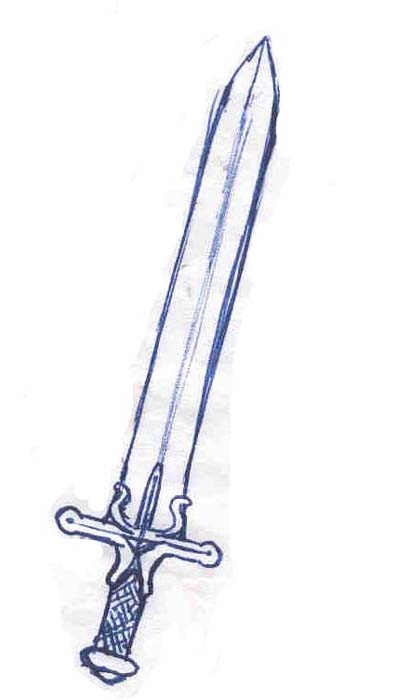
Here's a little weapon I created for all my nerdy D&D friends...:)

Blade of Daedalus
 
This unique broad sword is said to have been wielded by a skeptical young bard from Mosstone within the Tethyr region of Faerun. Mosstone borders the gigantic forest called The Wealdath and hosts a grove of powerful druids who run a school for the town's wealthier children. They focus on awakening spiritual potential and proper respect for nature and creation through prayer and ritual. Daedalus, at first a bright and obedient lad, became disillusioned with the strict dogma of the druids, and insisted there had to be more to the world. He decided to forsake his religion and leave Mosstone, traveling where the winds of beauty and exploration would take him. It is rumored the blade was forged by the elves living in The Wealdath after they heard of Daedalus' obstinate inquiries to his druid superiors and eventual banishment. It is said an elven envoy met Daedalus on his way north, along the Trade Way as it makes its route through the forest, and gave him the sword, granting him the blessing of Akadi, goddess of air and movement. Inscribed along the blade's edge are the Elven words for "silence, exile, and cunning."
            
Damage: 1d12 +4
Critical: 19-20/x2
Type: Slashing
Hardness: 10
Make: Elven
Usable by: Neutral
Immunity: Paralysis, Petrification, Slow
Once a Day: Silence (Lvl 2)
Once a Day: Globe of Darkness (Lvl 2)
Once a Day: Detect Thoughts (Lvl 2)

Wednesday, February 22, 2012

Chinook Winds

In Colorado, we have from time to time what one might call a ‘mighty wind.’ Racing through canyons, ricocheting off windows, and bending trees like rubber, the wind, which can reach 70 mph, can be a powerful, natural force. The winds, called Chinook or foehn winds, occur most frequently in late winter and usually provide a temporary rise in the temperature, but can be miserable and annoying to be in.

At my place last year, the wind always seemed to hit the night before the scheduled trash and recycling pick-up day. This would result in trash and recyclables (mostly recyclables since they weren’t bagged) being scattered across the lawns of every house on the street. Placing a brick on top of the toter lids offered little respite from the weekly hell winds. At my garden level apartment this year, even though the downstairs entrance faces east and the wind comes from the west, there always seems to be an accumulation of litter on the steps after heavy winds.

Since I have friends doing a similar task four or five days a week, I happily volunteered to reclaim the recyclable materials and properly dispose of the waste! As I picked up the chip bags, fast food bags, candy wrappers and just random plastic-styrofoam malarkey, I wondered at the source of this problem. I first asked myself could it be possible that nature has ways of spreading disorder through disasters like tsunamis and wind storms? If you look at before-and-after pictures of these natural disasters, you see whole communities torn apart and devastated, with litter lying everywhere, but the cause of the trash itself is not a natural one.

I eventually transitioned from blaming Mother Nature for the trash in front of my eyes, to realizing the manufactured convenience of humankind was responsible. Could it be divine will that trash be spread everywhere from the heavy winds so we see the error in our overly-consumptive lifestyles?

Waste was created by man alone; if you look at the circle of life in organic systems you realize that nothing is wasted. Moisture evaporates and condenses in the atmosphere, showering the earth with rain that gathers into bodies of water to be evaporated again, big fish eat little fish, and so on and so forth til the end of time. Somewhere way back in the history of homosapiens, this sustainable chain of life was broken, and hasn’t been the same since. In the words of Martin Luther King, Jr., “Somebody told a lie.”

I was once taught by a wise painter that a force exists in the universe called entropy, that the natural trend of things is to go from order to chaos if left undisturbed. Like a rope or cord that gets knotted if untouched for a period. Strict physicists forgive me, but is it possible that waste is just an untouched symptom of entropy, and humans aren’t treating it correctly? Because of it’s nature as disorderly and disgusting, trash is automatically delegated to the chaotic side of entropy, and it may be our job to bring order to it in the form of sustainability measures, and in the case of the Chinook winds, a sheltered waste disposal area.

The ways we can improve our communities and in turn the world are unlimited, but it must start with creating a space for positive change within ourselves. If we’re constantly attached to our routine of buying to-go meals, single-serving foods, and non-compostable/non-recyclable products, we’re never going to have a positive net impact on the environment. The current philosophy on distribution in America can be summed up by punk rock band The Dead Kennedys’ album name, “Give Me Convenience or Give Me Death.”

If we begin using and supporting products that are closer to home, use green energy, and have an end-of-life material recovery strategy, the obstacle of convenience will gradually diminish, and it’ll soon be easier and cheaper to attain them, from the larger demand as well as from our familiar routine of knowing where to get them. We will feel healthier mentally and physically, from the absence of strange chemicals known to cause cancer to the fact that we’re supporting farmers, entrepreneurs and manufacturers close to home.

On the other side of the ball are the producers who tell us the new ways are too expensive, won’t protect the product, or the materials aren’t durable, and there may be some truth to these claims. However, because something is cheaper to make doesn’t mean we should always use it. Look at housing materials. Again, carpenters forgive me, but you don’t want your house to be built with cheap composite wood and plastic siding; a mighty wind might knock it down. You want it to be made with stone and hardwood. Ironically, some of these longer-lasting materials are looked at as not eco-friendly, but their longer lifespans justify their use.

The bottom line is there is a plethora of useless packaging. Why do my saxophone reeds have to come in a gloss enameled paperboard box sealed by plastic, with the reeds inside individually wrapped in plastic? The answer is they come from France, and I have to say the reeds work better when they’re fresh, but they could just come in a recycled cardboard or paperboard box if they were made relatively close. Why do cigarettes come wrapped in plastic, with aluminum foiling around the top and non-compostable filters? Why do new electronics need to be encased in styrofoam, wrapped and sealed with plastic and those little black ties that end up in your drawer? Let’s be honest, why is styrofoam even being made anymore??

If we as a species are going to get real about protecting our homes and planet for future generations, we need to constantly question these norms of society that produce unnecessary pollution and heavy energy use. In the words of that wise painter-poet, Clint Richie, “Now is a point of awareness, now is conscious existence, now is a time for change. Change doesn’t mean conforming to the norm; change means thinking outside the deadly prison. Because the old ways just don’t work anymore. Sorry, we’re running out of time. We must change or we die.”

Tuesday, January 24, 2012

Origins of the word ‘Click.’

1581, of imitative origin; perhaps French or Dutch.
Probably developed earlier as a way to corral horses,
in expressing reprimand or sympathy, or produced in audible kissing.

Also, any of various stop consonants, found in Khoisan and as borrowings in southern Bantu languages, that are produced by the suction of air into the mouth.

The figurative sense of "fit together" first recorded in 1915.

Used as Canadian/U.S/European slang for kilometer,
sometimes spelled klik or klikken.

In computing, pressing and releasing a button on a mouse or other pointing device to cause an event in virtual space. Distinguished from “right-click;” the regular usage implies the left button.


Source: http://dictionary.reference.com/browse/click

Thursday, August 25, 2011

Solidarity Night

It’s been awhile since my last blog post on sustainability issues, and I know the thousands of my readers across the globe have been disappointed. I must apologize and give an explanation. My Mennonite Voluntary Service/Americorps assignment at Eco-Cycle in Boulder, CO ended, and I transitioned to another assignment at the Boulder Shelter for the Homeless. In both lines of work, there are challenges aplenty, but strangely, many similarities. I came up with the center of a Venn diagram, but sadly, don’t know how to create one on Wordpress.

They’re both nonprofits, with all the funding and tasking challenges that entails (Pick Up America can attest as well--matter of fact, while I’m on the subject, go to their Help! page ASAP). They both deal with cleaning up aspects of society that the average citizen disregards or attributes as disposable or unwanted. They both mitigate man-made problems, attempting to educate and offer solutions to said problems. They both enjoy immense, local community support, yet society as a whole and the establishment it helps elect has yet to implement many policy solutions they endorse. They both tango with hope and despair, and persevere for the simple fact that if you do not find a way, no one will.

However, in a note of positivity and the strange intercourse of zero waste and homelessness (and of all things), last October, community members and homeless volunteers in Boulder teamed up with Global Hope Network and Project Revive to clean up litter from Boulder Creek for donations. The project was a success not necessarily money-wise, but soul-wise, helping displaced individuals see the effect their work/worth has on the community around them as well as the global community, and would be a very cool model to try nationwide.

These kinds of projects tend to heal the community as a whole. I remember that in the build-up to the anti-globalization and free trade agreement protests in the late 90s and early-aughts, we always tried to stress the linkage of local to global. What does it mean that we pay 10 cents for a banana that was harvested by a subsistence farmer and transported all the way to the middle of our country? What does it mean that we’re not letting those same farmers unionize, that we enforce privatization on a nation’s oil supply, and make them pay for water? What does it mean that we’re mowing down much-needed canopies in a region that experiences the worst effects of global warming? “Think globally, act locally.” If you’re not safe, I’m not safe.

With monumental protests that bring light to an issue like the Battle of Seattle aside, projects like Pick Up America and Project Revive that make commitments at a grassroots level tend to have a greater impact than protesting. The dedication and sacrifice to pick up roadside (or creekside) litter out in the sweltering, summer sun mirrors that of the poorest farmers in the developing world building irrigation channels and tilling the Earth simply to survive. And it’s tough coming from a privileged background, knowing that your peers are doing big things, going to grad school and earning salaries commensurate with that same farmer’s lifetime income. But somewhere, somehow, you must pull that strength from deep within you, to continue struggling another day so that “liberty and justice for all” is not just something a schoolchild recites each weekday morning. Make it real, keep it real, love it real.

Friday, July 2, 2010

MLK Memorial Close to Finishing!

When I made forays into Washington DC from Maryland with my friends in high school, sometimes with the intent to protest or hand out PB+J sandwiches to the homeless, our paths would often take us past various statues that dotted the circles and avenues of the center of the city. Most of the time, we would either make jokes about some long-forgotten geezer given a memorial for some long-forgotten deeds in long-forgotten wars. Sometimes we would just pass by without even thinking twice about what we had just seen. We were concerned about the problems of the day. We would not care to ask our history teachers later about the figures in question. Even when we made it to the Mall and the larger monuments, we would spend little time, if any, admiring the scenery. This was due, perhaps, to adolescent indifference, or the fact that most of us had seen all the big attractions (most of us had been subjected to the routine round of historical sites) every time relatives came to visit.

I can think of two statues which prompted different behavior, however, and these are probably my favorite symbolic pieces of metal and stone in D.C. First, the ten foot high stone statue of Mohatma Gandhi striding with his walking stick (Q St. across from the Indian Embassy). Gandhi is well known to many for his non-violent resistance to the British and his role in helping to end British colonial rule. Secondly, the Guns into Plowshares sculpture, formerly located in front of the municipal court building at Judiciary Square. Few know about the District's Guns for Cash program in the 1990s that turned hundreds of used firearms into a modern interpretation of Isaiah 2:4: They shall beat their swords into plowshares, and their spears into pruning hooks: nation shall not lift up sword against nation, neither shall they learn war any more. Both of these sculptures represent aspects of peace or hope for the future, things I believe should be memorialized more than any war, war hero(es), or presidents. We have memorials to every extended conflict in American history, but the grandiose memorials to the men and women of peaceful struggle, loving compassion, and conflict resolution are missing. What does this say about our country, the dream?

"A nation that continues year after year to spend more money on military defense than on programs of social uplift is approaching spiritual doom."

A memorial which has great potential and the promise of exemplifying values of love and peace, and has been in the works for nearly 16 years, is the Martin Luther King, Jr. Memorial. Groundbreaking and preliminary construction has already commenced, and the full memorial is expected to be done and dedicated in fall 2011. The steering committee is currently $6 million off it's target of $120 million, and appreciates individual donations as well as larger fundraising commitments or ideas. You can donate and learn more at www.mlkmemorial.org.

The site lies among the cherry trees of the Tidal Basin, directly in the middle of the Lincoln and Jefferson Memorials. It is fitting for King's memorial to lie between two presidents who directly impacted the Civil Rights movement, one who owned slaves yet helped lay the foundation for equality and justice between all Americans, and one who freed African-Americans by signing the Emancipation Proclamation. The site is also close to the Korean War memorial, and relatively close to the Vietnam War memorial, two wars that King protested and preached against fervently. It would be fitting to find a site close by to move the Guns into Plowshares sculpture, for while it was created to shed light on the need to stop gun violence in our cities, it was created, nonetheless, out of guns from the capital city of the government that King declared to be "the greatest purveyor of violence in the world."

"And I knew I could never again raise my voice against the violence of the oppressed, in the ghettos without having first opened clearly, the greatest purveyor of violence in the world today: my own government."

I have not seen the list of quotes that will be inscripted on the memorial wall; there are almost too many good ones to use, but it is doubtful that such radical quotes like the ones above will be included, a most unfortunate tragedy but predictable considering the official dignitaries and corporate sponsors involved. For indeed, there are Americans today that still don't agree with King's politics, and not just with regards to racial equality. How many Americans would react negatively to King's scathing disapproval of two ongoing wars (of empire some would say), a bill that racially profiles Americans of Latino origin, the lack of a living wage bill, the failures of our public health and social services sectors in the face of a staggering defense budget??

King preached about a radical Christ; one who disrupted the status quo and disturbed his neighbor by speaking truth to power, raining down compassion on the poor, and loving his enemies. More so than studying Gandhi's tactics, King's theological studies and faith in the true words of Jesus Christ laid the foundation for his inspiring rhetoric of nonviolent resistance to war, imperialism and discrimination. His last words in public, from his speech "I Have Seen the Mountaintop" in Memphis the night before he was assassinated, are "I'm not fearing any man! Mine eyes have seen the glory of the coming of the Lord!"

It was this radical Gospel, and the radical dreams it inspired, which made King, just like Jesus, a threat to the existing system, and that's why he was eliminated, just like Jesus, just like Gandhi, just like a host of other 20th century cultural icons and movement leaders. If you consider yourself a follower of King, you may ask yourself, am I a threat to the existing system? In what I do every day, do I challenge the orthodoxy of injustice, the conformity of apathy? While some would argue human relations and our standard of living have never been greater, we still have immense problems to take care of and sacrifice for.

"It is not enough to say we must not wage war. It is necessary to love peace and sacrifice for it."

Considering the amount of young Americans who will see this memorial, it seems pertinent to inspire in them a radical desire for change, not just teach them the standard, watered-down versions of this trying chapter in our history. Because if the record is not set straight, and young Americans continue to fall into despair, and don't have honest beacons of hope and inspiration, then history will repeat itself, violence will not be eradicated, and injustice will continue. Because after all, to paraphrase King again, out of a respect for the law, unjust laws need to be broken, and violence has failed us. Nonviolence is the only way.

The memorial needs to be (and will hopefully be) exciting and ring true for future generations, so as not to pass the memorial off as another insignificant statue in a succession of long-forgotten men who may or may not have affected positive change for our country, the dream and our world.

Wednesday, June 2, 2010

The Advent of Reverse Vending Machines

Initiatives to increase recycling rates through logistical partnerships and innovative marketing are cropping up everywhere, but perhaps none of the proposals have the potential or incentives to capture more of the recyclable waste stream than Reverse Vending Machines (RVMs). These somewhat-portable machines look like your average pop machine, but instead of putting money in to receive that dose of high fructose, you put your empty soda bottle or aluminum can in and receive money, or at least redeemable gift cards, coupons or online points. Invented in the mid-eighties, (the nineteen-eighties), RVMs have come a long way, and are ready for widespread usage. Check out what they used to look like (and still do in some places) and what they look like now. Some have flashy LED displays capable of advertising, while others have larger container capacities, crushing mechanisms or accept other materials like glass and electronics.

The idea for RVMs stems from research showing that people are more likely to recycle if a) there's fun, interactive rewards involved and 2) there's a close location nearby to toss that on-the-go container. This video provided by TheFunTheory.com shows an experiment involving a RVM wired like an arcade placed in a highly visible public place, and the resulting interest of people passing by. It's amazing what flashy, colorful lights and synthetic sounds can do; just look at Vegas. These reverse vending machines also address the issue of contamination by scanning each package that they receive, sorting the material into its proper pile, making it easier for pick-up to a transfer station or recycling center. While some of these machines are privately-contracted in bottle bill states, they will have more of an impact in deposit-less states (IMO) by providing access and a reason for recycling.

The new generation of RVMs is quite impressive. Norway-based TOMRA is a vendor of at least five different types of RVMs, which have appeared in stadiums and college campuses across the U.S. The start-up company ecoATM, Inc. has developed a machine that accepts cell phones, and has plans to accept other electronics such as laptops and mp3 players, providing a good e-waste solution. They currently only operate RVMs at the Nebraska Furniture Mart in Omaha and Kansas City, and about seven different Westfield malls in southern California. Pepsico and Waste Management have teamed up with GreenOps to manufacture what they call The Dream Machine in hopes of reaching a recovery goal of 400 million containers annually. This RVM accepts PET bottles and aluminum cans and there are plans for several thousand of them to be distributed across the country. Currently, there are only 150 in Rite Aids across North Cackalacky (random right?) as a trial program. You can redeem rewards with an account at Greenopolis.com or sometimes the host venue, I guess in this case, Rite Aid.

The potential locations for RVMs are endless. College campuses could put them in high-density locations like food courts, and the students could redeem containers for points/dollars (I believe they were called TerpBucks at UMD) on their university cards to buy that overpriced, late-night, C-store snack. Stadiums could have RVMs that give you discounts on that even-more-overpriced-than-campus-C-store food and drink. Hospitals produce tons of plastic and aluminum from patients' meal trays every day and would greatly decrease their waste disposal costs with RVMs. State and national parks could have them at their campgrounds keeping containers off trails. Festivals and big, public celebrations could have them to collect the tons of container waste that they produce. Boardwalks and beaches would benefit immensely by a RVM collecting empties from all raging going on; just imagine one in walking distance from that over-crowded rental you stayed in at Beach Week. Putting one side-by-side wherever there's a real vending machine would go a long way as well.

Hopefully, we will start seeing reverse vending machines and other fun, collection technologies become ingrained in our culture. I have yet to see one in action in my own daily experience, possibly showing that they still have a long way to go, but perhaps I don't get out enough. I'd love hearing from people who have used one.

What does all this mean for municipal recycling programs? If enough aluminum and glass, which are high-value materials, are diverted from normal recycling centers, it's possible the economic feasibility of operations would suffer, since newspaper consumption is rapidly declining and plastic pays shit. However, a lot of these machines need a place to transport and recycle their containers, and the closest place would be the local recycling center. The verdict is still out on the impact and future RVMs will have, but I suspect they won't affect municipal recycling operations adversely, and might even benefit them by increasing material coming in. Without a doubt though, reverse vending machines will increase recycling and waste diversion rates, thereby benefitting our Earth.

Wednesday, May 26, 2010

My Journey Thus Far

(written for and orated at BMC Service-11/29/09)

My faith journey can be summarized into two main areas: music, and a commitment to peace and social justice, and yet I cannot begin to think about my faith without acknowledging the presence of family, specifically parents and grandparents. I come from a family long-rooted in the Mennonite tradition. Both my grandpas were heavily involved in some aspect of the church. My grandpa on the Goering side was involved with lobbying President Roosevelt to legalize conscientious objector status for Anabaptists during World War 2 and afterwards became a pastor at churches in Witchita and Goshen. My grandpa on the Fretz side was a sociologist who studied and wrote books on Mennonites in Canada and Paraguay, and helped start Conrad Grebel college in Waterloo, Ontario. He was the acting president there for several years as well as interim president of Bethel College for a year. I will always remember two walks I had with each; one with Grandpa Goering along the shores of the Outer Banks in North Carolina when I was just becoming a teenager, and one with Grandpa Fretz, probably the last walk I took with him, taking place along the wooded path that leads from Bethel past the Kaufmann museum on to Kidron, right around the time I was starting college. Both walks I was not inclined to offer or accept any profound utterances on the nature of the world, due to a period of adolescent silence although I was always a good listener, leading my Grandpa Fretz to declare for me that "it's better to remain silent than be thought a fool."

My whole family went to Bethel College; mother, father, brother, aunts, uncles, several cousins, and so I was always around Newton in the summers for reunions and other such activities. As I grew up, I became bored with small town life, a fact which led to my announcement that I would be the first in the family not to attend Bethel, and ended up graduating with an English major/Philosophy minor from the University of Maryland in addition to a Freshman year stopover at Loyola University in New Orleans. Big city living was fun while it lasted but ultimately not healthy or sustainable, and now I realize I would have been perfectly fine following my parents and attending Bethel. My recent change of opinion is due in part to sharing some good times with Bethel alums, particularly my brother's graduation party and wedding out among the wheat fields of Kansas. It reminds me of a scene from Portrait of the Artist as a Young Man by James Joyce, where a priest asks young Stephen Dedalus if he loves his mother, why doesn't he just follow what she wants for him?

I was quite the stubborn and rebellious spirit growing up, always trying to get what I wanted and questioning the norm. When we went to church, I was the younger brother from "A River Runs Through It," slouching against my mother asking for candy, or heavily invested in whatever book I had at the time, and only paying attention when it came to singing hymns and the childrens story. To this day, hymns are my favorite part of worship, but I can't say I get much from the childrens time anymore. Fortunately, I found vectors to soothe my rebellious inclinations in picking up the saxophone in the 4th grade and co-founding a student group in high school called Students for Social Change.

Music was encouraged through the Goering side. My Grandpa plays Joy to the World on piano every Christmas morning to wake everybody up. He forced my dad and his sister and brother to pick up instruments throughout their schooling. My dad chose the Tenor saxophone and still plays, although with not as much tenacity as earlier on in his career. We actually have a small jazz combo that plays periodically at Hyattsville Mennonite Church and around the Washington, D.C. area. My brother and I were similarly forced to pick up instruments, and while I loathed practicing every day, picking up a new instrument is frustrating and requires discipline!, I'd say one of the greatest gifts a parent can give and teach to a child is an artistic outlet. Music for me is spiritual, relaxing yet stimulating, satisfying yet mystifying and always calling to me. I couldn't get rid of it if I tried, like God. I wouldn't want to live in a world without it, like God.

Students for Social Change, or SFSC as we called it, was entirely student-run and organized around different issues we felt strongly about including homelessness, globalization, political prisoners, the death penalty and the wars in Iraq and Afghanistan. We would make sandwiches and walk around our nation's capital with a boombox feeding the homeless. We were involved with numerous protests, including the World Bank/IMF struggles of the early 2000s, and the massive anti-war marches that failed to stop the inevitable tragedy from unfolding. The height of Students for Social Change consisted of a county-wide walkout in 2003, linking up with our brethren from the D.C. school system, and followed up by a Valentine's Day concert featuring the movement-encompassing message Make Love, Not War.

The middle years of this decade were some of the darkest for me spiritually. Don't get me wrong. I had tons of fun in high school and college playing in different bands, traveling on sporadic road trips, writing and organizing, and other rawkusing in general, but I was always haunted by the question of how could God allow so much suffering in the world? Why were the people in power so heartless and greedy? I still struggle with these questions but several developments have alleviated the pessimism. While my faith was virtually absent during this period, I took solace in words, reading whatever professors would throw my way, and I began writing my feelings through poetry and song lyrics. Writing comforts and strengthens me, gives me a sense of achievement, and perhaps led to where I am currently. The election of Barack Obama also helped, and was literally like a candle snuffer being pulled back to reveal the candle still lit, although some of the promised changes seem to be taking awhile...

Studying philosophy and literature led me to the conclusion that everything is determined, everything is meant to happen. God has a plan, and God is the dramatist. All the world's a stage and God is the audience. In the words of Gandalf from the movie versions of Lord of the Rings, Bilbo was meant to find the ring, in which case, you were also meant to have the ring. I was meant to come to Boulder, I don't know what for exactly, but from an objective bystander observing the time line and subsequent unfolding of the universe, it was not my choice. Each of you were meant to be sitting in the chairs that you're seated in. All you have to do is decide what to do with the time you're given. God not only has a plan, God is the plan. I once asked my mother at a young age what and where God was and she responded "God is everywhere. God is everything." This befuddled me for awhile (many years), but with my realization that determinism and creation go hand in hand, that there is an illusion of free will that veils us from the true spiritual realm, and everything is in God's hands, allowed for this reality to set in. All you have to do is walk in the light, show some love, forgive others, resist temptation, be a witness to God's creation. God will take care of the rest. This doesn't exactly take care of the poor people suffering, but spreading the message of love and forgiveness like Christ did before us will hopefully change something in the world. I've also learned that its better to lead by example, rather than by telling someone how to live.

Two international trips helped me come to this conclusion, one having to do with peace and justice studies and the other having to do with music. They both happened in the month of January, two years apart. The first was a sojourn study group with Patty Shelley and Bethel College Winter Term to Israel, Palestine and Jordan in 2007. Seeing the Holy Land, and locations where events in the Bible take place really strengthened my faith and belief in God. I recommend a similar trip to everyone here. While violence is a reality there, life is fairly normal and safety as an American is generally ensured. Patty Shelley is a voracious singer for those that may know her. We would usually sing a hymn at significant sites and churches in the area, sometimes to the applause of other tourists, and we sang the hymn "Seek Ye First" in a church on the Mount of Olives, which had a tear-shaped window that overlooked Jerusalem. The occupation that Israel lords over the Palestinians, the discrimination shown to Arabs, even Israeli Arabs, the racist government that claims to be democratic, frankly needs to stop, and the conflict is in my prayers daily. When I saw for the first time the giant security wall that tore through the olive fields of Bethlehem, I nearly broke into tears. I hope that one day it will be torn down in similar fashion to the Berlin wall.

The second trip I took was with friends this past January to the mystical island of Jamaica. This was the first time I had traveled south of Orlando, Florida, and while I was somewhat worried going to a third world country, everyone was friendly, sometimes too friendly, but nonetheless warm, genuine, and possessing spates of wisdom that made you rethink outlooks on life. Everything is about respect and no worries, keeping the faith in Jah, meditating daily, dancing and playing music. The language, and music for that matter, once you can decipher it, is uniquely colorful and illustrative, preserving social integrity and promoting moral revolution. Words like Babylon, bredren, inity, respect, ovastanding all play into the spiritual mix. Rastafarianism takes its roots from Ethiopian Orthodox Christianity, and my explorations into it have delivered me to a strong and positive place in life that enrich the rebel soul within me.

Clearly, freedom of religion and general social acceptance have not been extended to Rastafarian brothers and sisters. Like Anabaptists and Palestinians, Rastafari stems from a theology of protest and martyrdom in refusing to be enslaved to authorities, specifically White male authorities. And while there are similar struggles to the Mennonite church in regards to the question of homosexuality and women empowerment, the language of liberation and personal empowerment and happiness is prevalent throughout rasta, a lot of who follow the teachings of Christ and debate scriptures with each other over games of Dominoes. Survival. Sacrifice. Solidarity. As the legendary Jamaican singer Peter Tosh sang, "If He was here, right now, he'd go to the jail the same."

While hybridization of religion and worldviews is possible from an individual standpoint, I don't know what do you think of Mennonite Rastas, I must admit I feel more attached to the Mennonite church because of my roots there within, but I am always curious to explore deeper meditations. I am glad that you all have accepted me here at Boulder Mennonite. I've made many friends here in colorful Colorado, and I look forward to meeting those that I haven't already.

In conclusion, it is what it is. I am what I am. Take it for what it's worth. And yet it can't be an individual effort, strength comes from togetherness and community. "For where two or three are gathered in my name, I am there among them." And I can't tell you what is needed to be done. I feel like the pulpit shouldn't be used for politicking and yet as Newt Gingrich put it in a recent Meet the Press interview on education, "Politics is the art of the possible." And God is what's possible. To quote Matthew 18 again, "Truly I will tell you, whatever you bind on earth will be bound in heaven, and whatever you loose on earth will be loosed in heaven." If that is the case, I pledge to fight for equal rights, spread the message of love and peace, and to incorporate music into everything I do.

And I leave you with a quote from Portrait of the Artist as a Young Man. "I will tell you what I will do and what I will not do. I will not serve that in which I no longer believe whether it call itself my home, my fatherland or my church: and I will try to express myself in some mode of life or art as freely as I can and as wholly as I can, using for my defense the only arms I allow myself to use, silence, exile, and cunning."